
From Riverbed to Barren Fields: How Sand Mining Fuels Climate Strain in Ugenya, Siaya
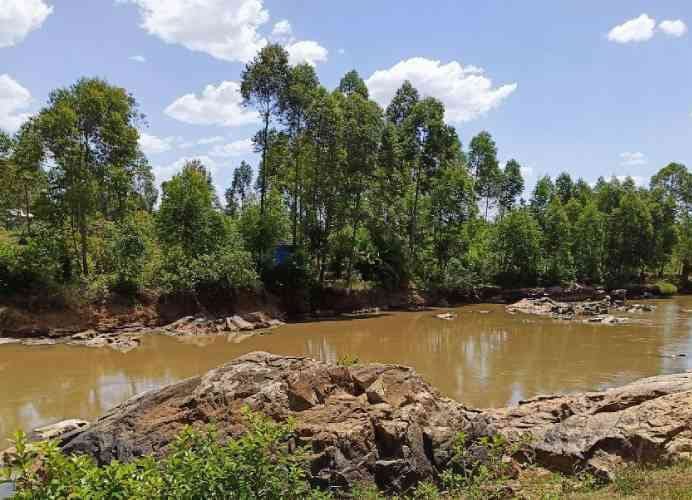
For generations, communities living along River Nzoia in western Kenya have depended on its waters and fertile banks for farming, fishing, and daily life. But in recent years, an invisible crisis has been unfolding unregulated sand harvesting. What once seemed like a source of quick income has steadily transformed into an environmental disaster, eroding land, lowering soil fertility, and disrupting ecosystems. The effects are now being felt far beyond the riverbanks, manifesting in declining food production, increased human-wildlife conflict, and broader climate change impacts.
Farmers cry
Under the scorching afternoon sun, Jackob Omondi Otieno,a young man and a farmer from Anyiko Vilage,East Ugenya Ward stood at the edge of what used to be his farm. Today, part of it lay swallowed by the widened river channel.
“This land fed my family for many years,” he said quietly. “Now the harvest keeps reducing every season.”

Otieno recalls how yields began to drop as the riverbanks weakened. The once-rich soil has been washed away, leaving behind dry sandy patches that can barely support crops.
“Around 2020 when I started farming, there was a great flooding around here,I had planted beins,they were doing well until were affected by floods.” He says
“I took a break and later planted maize, it did even worse, we had to feed the maize plants to the cow, I think that flood swept away all the top soil that carries nutrients.” Otieno adds
His story mirrors that of many farmers along River Nzoia, where uncontrolled sand harvesting has led to severe erosion and loss of arable land, threatening food security in the region.
With less food being produced, families are forced to buy what they once grew, deepening poverty and vulnerability to climate shocks.
A Frightening Encounter
For Christine Anyango Ogola, a local resident in Uring Village, the changes are not just about farming, they are about survival.
“One evening, as she walked to fetch water, she froze. Coiled near the riverbank was a massive python.
“We never used to see such animals near our homes,” she recounted. “Now they come closer. I think it’s because their habitats are disturbed.”
Environmental degradation caused by sand harvesting destroys riverine ecosystems and vegetation, pushing wildlife out of their natural habitats. As animals search for food and water elsewhere, they increasingly encroach on human settlements, leading to dangerous encounters like Mrs Ogola’s.
And this animal encroachment is still a problem to the farmers taking them at a loss as recounted by Mr.Otieno
“There have been more hippo attacks, mostly in our farms. Sometimes as a farmer I’ve made an agreement with a client and even collected deposit for kales, and then the next day you go to harvest and find that hippo has eaten all your vegatables.”
“So you don’t have the kales and already spent the money, you’ll definitely disappoint your clients” He adds
The Agricultural Officer’s Warning
According to Mr. Evans Odipo, Ugunja Ward Agricultural Ofiicer, the science behind the crisis is clear.
“Sand harvesting removes the topsoil and weakens soil structure. Without fertile soil, crop productivity declines sharply.”
He explains that the process lowers the water table and strips away nutrients essential for farming.

Studies show that sand harvesting degrades soil quality, reduces land productivity, and disrupts biodiversity. Even more concerning, he notes, is how this contributes to climate change:
- Loss of vegetation reduces carbon absorption
- Dry, degraded land increases surface temperatures
- Altered river systems affect local rainfall patterns
“These changes create a cycle,” he adds. “Less vegetation leads to less rainfall, which leads to even lower food production.”
The NEMA Director Speaks
At the county level, environmental authorities are increasingly alarmed. Rob Kipkoech is the county director from the National Environment Management Authority (NEMA), emphasizes that laws already exist but enforcement remains weak.
“There is a River protection act 2024,it allows sand harvesting only in temporary Rivers.” He Pauses.” River Nzoia is a permanent River,so no harvesting should take place there.”

NEMA has, in some areas, even banned sand harvesting along rivers to protect fragile ecosystems and wildlife habitats, stressing the need for compliance with environmental management conditions.
“Even in the legalized areas,harvesting should be done inside the river bed, not along the river banks” Mr.Kipkoech says.
He warns that without strict enforcement, the damage to rivers like Nzoia could become irreversible, affecting not just local communities but entire ecosystems.
The story of River Nzoia is a powerful reminder of how human activity, when left unchecked, can disrupt the delicate balance between people and nature. Unregulated sand harvesting is no longer just an environmental issue, it is a climate issue, a food security issue, and a human safety issue.
From the farmer who can no longer harvest enough, to the resident facing wildlife at her doorstep, to experts raising alarm over soil degradation, the message is clear: action is urgently needed.
If sustainable practices, strict enforcement of policies, and community awareness are not prioritized, the river that once sustained life may continue to fade taking livelihoods, ecosystems, and future generations with it.
Comments